
What Production Managers Wish Their ERP Could Tell Them
Manufacturing has never been more demanding. Customers expect shorter lead times, supply chains remain unpredictable, labor remains difficult to acquire and retain, and margins are constantly under pressure. In this environment, production managers are expected to make dozens of critical decisions every day, often with incomplete information.
Most ERP systems contain an enormous amount of data. Unfortunately, having data and having answers are not the same thing.
Production managers do not wake up wondering how many records sit inside the ERP database. They want to know whether today's production schedule is at risk, which customer order needs immediate attention, and what obstacles might impact delivery performance next week.
The truth is that many ERP systems function more like historical record keepers than decision-support tools. The most successful manufacturers, however, are finding ways to transform their ERP systems into visibility engines that provide actionable insights rather than simple reports.
Here are five questions production managers wish their ERP could answer instantly.
1. Which Jobs Are At Risk Right Now?

Production managers are constantly balancing competing priorities. Every day brings machine interruptions, material shortages, employee absences, engineering changes, and unexpected customer requests.
The challenge isn't the lack of information. The challenge is identifying which issues actually require immediate attention.
Instead of manually reviewing schedules, open orders, and work center reports, production managers want an ERP system that proactively answers:
· Which jobs are most likely to ship late?
· Which work orders are falling behind schedule?
· Which customers will be impacted if no action is taken?
· What jobs should be expedited today?
An ERP equipped with real-time visibility can highlight exceptions instead of forcing managers to search for problems manually.
Imagine beginning the day with a dashboard that clearly identifies the five orders most at risk and the root cause of each delay. A production manager can then spend time solving problems instead of hunting for them.
The difference is significant. Organizations that respond to issues early often avoid costly overtime, expedited freight, and customer dissatisfaction.
2. Where Are Our Inventory Blind Spots?

Inventory represents one of the largest investments on most manufacturing balance sheets.
Yet many organizations still encounter situations where the ERP says materials are available while the production floor tells a different story.
At the same time, companies frequently discover excess inventory consuming valuable cash while other critical components remain chronically short.
Production managers want immediate answers to questions such as:
· Which materials are likely to become shortages in the next two weeks?
· Which inventory items have not moved in six months?
· Which purchase orders threaten upcoming production schedules?
· Which products experience the most frequent stockouts?
Traditional inventory reports often reveal problems after they occur.
Predictive inventory visibility allows manufacturers to anticipate shortages before production stops. By connecting demand, purchasing activity, inventory levels, and open work orders, the ERP can provide early warnings that enable proactive decision making.
When managers understand inventory risk before it becomes a production problem, they can reduce disruptions while improving working capital performance.
3. Are We Actually Making Money on This Job?

One of the most common challenges manufacturers face is determining true job profitability.
A job may appear profitable when quoted, yet unforeseen labor requirements, material increases, outside processing costs, and schedule disruptions can quickly erode margins.
Production managers often lack visibility into actual performance until weeks after a job is completed.
Instead, they want answers such as:
· How does actual labor compare to quoted labor?
· What is the current estimated margin on this work order?
· Which products consistently exceed estimated costs?
· Which customers generate the strongest profitability?
When visibility into margins becomes available in near real time, managers can take corrective actions before losses accumulate.
For example, supervisors may identify opportunities to improve routing efficiency, reduce machine setup times, minimize scrap, or better allocate resources.
Profitability insights also improve future estimating processes. The more accurate the historical data, the more competitive and lucrative future quotes become.
In many cases, the greatest opportunity for margin improvement isn't increasing sales – it's understanding which activities are quietly consuming profits.
4. Can We Finish On-time Next Week?

Most ERP systems provide scheduling tools, but relatively few provide true forecasting clarity.
A schedule may look achievable today, but what happens when a machine goes down tomorrow? What if supplier deliveries arrive two days late? What if production demand increases unexpectedly?
Production managers need forward-looking answers such as:
· Will we have enough labor available next week?
· Which work centers are approaching capacity?
· Where are scheduling conflicts developing?
· Which customer commitments are vulnerable?
This type of insight allows companies to move from reactive planning to proactive strategy.
Instead of waiting for a bottleneck to appear, managers can re-balance workloads in advance. Instead of discovering capacity constraints after orders are accepted, they can make informed decisions beforehand.
A modern ERP environment should not simply document what happened yesterday; it should help predict what may happen next.
That shift from hindsight to foresight often represents one of the biggest competitive advantages available to small and mid-sized manufacturers.
5. Why Did Production Miss Plan?
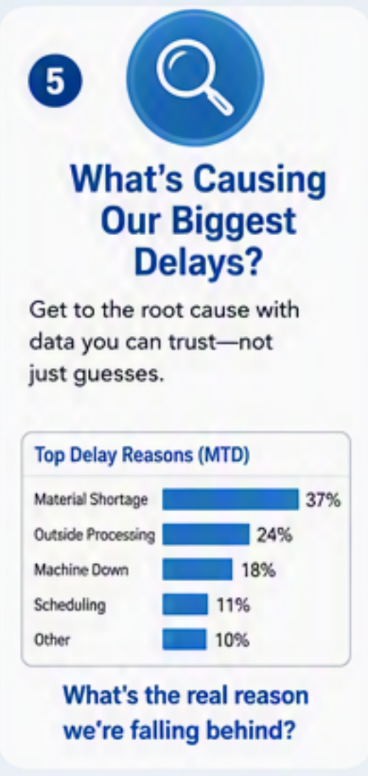
Perhaps the most frustrating challenge for production leaders is understanding why objectives were missed.
Most manufacturers track performance metrics such as:
· On-time delivery
· Labor efficiency
· Throughput
· Scrap rates
· Machine utilization
However, identifying the underlying causes behind poor results can be difficult.
Production managers frequently ask:
· Was downtime the primary issue?
· Did material shortages cause delays?
· Were scheduling decisions responsible?
· Did quality concerns interrupt production?
· Are specific work centers repeatedly creating bottlenecks?
Knowing what happened is helpful.
Knowing why it happened is transformative.
Modern reporting and business intelligence tools can consolidate information from across the organization and reveal patterns that are difficult to detect manually.
When organizations understand root causes, improvement efforts become dramatically more effective. Rather than treating symptoms, they can address the processes creating the problems.
For many manufacturers, the ERP already contains much of the information needed to answer these questions.
The challenge lies in transforming raw data into actionable intelligence.
This is where advanced reporting, dashboards, business intelligence tools, and ERP optimization initiatives can deliver substantial value.
Whether through database enhancements, custom reporting, Power BI dashboards, or operational technology integrations, manufacturers are increasingly seeking ways to gain faster answers from existing systems.
The goal isn't necessarily replacing an ERP.
The goal is making the ERP smarter.
Final Thoughts
Production managers operate in environments where every decision carries consequences. Customer satisfaction, profitability, operational efficiency, and employee productivity all depend on making the right decisions at the right time.
The question is no longer whether manufacturers have enough data.
The question is whether their ERP is delivering the answers they need.
The manufacturers that thrive over the next decade will not simply be the ones collecting the most information. They will be the ones that transform information into insight, insight into action, and action into measurable business results.
At Cincinnati Software Solutions, we help manufacturers unlock greater value from their ERP investments through platform expertise, business intelligence solutions, custom reporting, and production technology support. If your ERP isn't answering these five critical questions, it may be time to discover what it's capable of telling you.


Comments